From Separation to Interbeing
Walking at the Speed of Trust
What unfolded in our recent Conversation That Matters on From Separation to Interbeing on January 15th was not a linear discussion, but a living inquiry—one that moved through paradox, tenderness, intensity, and unexpected clarity.
Again and again, we found ourselves returning to the both/and nature of this exploration. Separation and interbeing are not opposites to be resolved, but a dance to be lived. One noticed how quickly we may scan for safety in our lives—an old, protective pattern that quietly shapes how we show up. Separation, it seems, often begins not “out there,” but within.
Several reflections pointed to a subtle paradox: the line between inside and outside is far thinner than we assume. When we are always looking outward—for answers, for certainty, for something to fix—separation deepens. Yet when we turn inward with curiosity, when we truly listen without searching for conclusions, something begins to soften. The boundary between inner and outer loosens. Like a coin with two sides, they are distinct, yet inseparable.
At moments, the language became even more elemental. Separation was named as impermanence—always moving, never fixed. Boundaries dissolved into waves and intermingling. Some spoke of realizing that separation itself may be an illusion learned over time: there is no clear divide between the experiencer and the experience. I am the experience. Naming, judging, observing from a distance—these can create a sense of “not me,” and in doing so, reduce who we are.
Other reflections touched the heart of belonging. When we “other” someone or something, we may also be losing touch with ourselves. In those moments, identity collapses into negation—I am who I am not. Several voices named a deeper remembering: belonging begins within. Trust begins within. Without interbeing inside ourselves, how can we fully dance with others?
This inquiry did not shy away from darkness. Questions arose about nurturing and depleting energies, about how to stay in relationship with what is difficult without being consumed by it. One participant spoke of wanting to walk with separation rather than rush past it—to move at the speed of trust, allowing integration to unfold in its own time. Another noticed how seriousness can creep in unnoticed, narrowing the field of possibility.
And then there was fire.
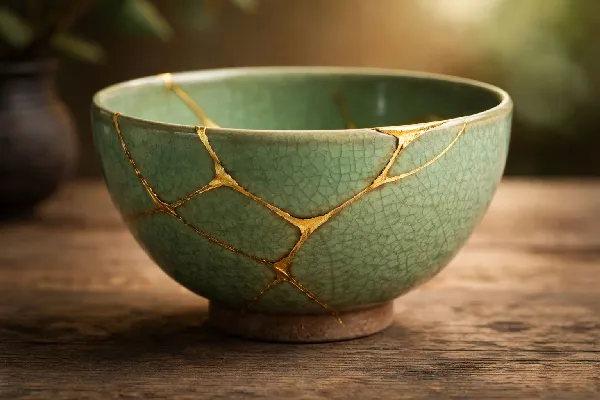
Alongside softness, a fierce aliveness emerged—a refusal to shrink or sanitize the fullness of experience. Wholeness was claimed not as gentleness alone, but as the freedom to be everything we are: dark and luminous, tender and strong, wounded and radiant. One image lingered powerfully: the Japanese art of repairing a broken vessel with gold (Kintsugi), making the cracks part of its beauty. Not erasing the wounds, but honoring them as part of the whole.

Photo by Mirella Callage on Unsplash
Across all these threads ran a quiet longing—to slow down, to soften our voices, to go deep with one another, to create spaces where all of it is welcome.
This conversation did not give us answers. What it offered instead was a shared sensing—a felt experience of what becomes possible when separation is not avoided, but met with presence, curiosity, and trust.
The inquiry is not complete.
On January 29th, we will dip into The Practice of Interbeing in an open Bohmian-style Dialogue, where we will listen together without agenda, allowing whatever wants to emerge to do so in its own way. If you were present for this first conversation, the dialogue offers a chance to deepen and unfold what has already been stirred. If you registered but couldn’t attend, this is an open door back into the inquiry.
Interbeing is not something to understand once and for all.
It is something we practice—moment by moment, together.
We hope you’ll join us in the Practice of Interbeing on January 29th!
About Kintsugi

Kintsugi literally means “golden joinery.” It is the practice of repairing broken pottery using lacquer mixed with powdered gold, silver, or platinum. Rather than hiding the cracks, Kintsugi highlights them—making the breakage visible, honored, and integral to the object’s beauty.
Philosophically, Kintsugi rests on a few profound principles:
Breakage is not failure – it is part of the object’s history
Repair is not erasure – it is transformation
Wholeness includes the wound – nothing is excluded
In Kintsugi, the vessel does not return to what it was before. It becomes something new: more complex, more honest, more valuable precisely because it has been broken and mended. The cracks are not a flaw—they are where the light enters.
Kintsugi embodies the movement from separation to wholeness not by denying rupture, but by staying present with it long enough for meaning, beauty, and coherence to emerge.
In relationship to our conversation on separation to interbeing:
Separation is the break
Presence is the patient holding
Interbeing is the gold that joins what was never truly apart
It’s a living reminder that healing—personal or collective—is not about returning to an imagined unbroken past, but about learning how to be whole with what has been lived.