
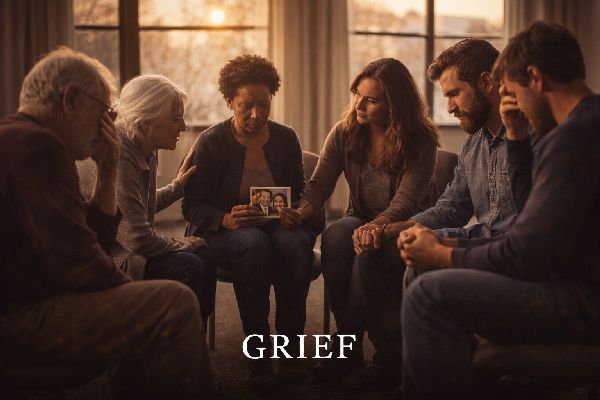
Grief as a Collective Teacher
Grief: Where Love becomes Visible
A reflection from our April 9 Conversation That Matters
On April 9th, we gathered in a Conversation That Matters to explore a question that is often felt, but rarely spoken together:
What is grief asking of us—individually and collectively?
We began simply.
Where have you noticed grief touching your life recently—whether personal or collective?
The responses came from many directions.
For some, grief arrived through the world itself—the wars, the chaos, the incomprehensible violence. A question echoed beneath it all: How can we do this to one another? There was a sense of disbelief, even insanity. A recognition that in our grief, we sometimes project evil onto others in order to justify harm.
For others, grief felt more distant. Not absent, but harder to access. Something inherited. Something known through memory rather than direct contact. A kind of quiet disconnection.
And for some, grief was intimately known.
The loss of a loved one.
The ache of absence.
The way grief, once entered, opens the capacity to see it everywhere.

Grief Is Always Here
As the conversation unfolded, a subtle understanding began to take shape:
Grief is not an interruption to life.
It is part of life.
It lives in beginnings and endings.
In change.
In love.
And yet, many of us resist it.
There was a shared recognition of how uncomfortable grief can be—how quickly we move away from sorrow, especially when it becomes collective. The scale of the world’s pain can feel too large to touch.
And yet, something else was also seen:
When grief is allowed—when it is expressed and deeply heard—there is relief.
Not because it is solved.
But because it is no longer carried alone.
Grief and the Human Condition
The conversation moved into the paradox of our time.
We are more connected than ever through technology,
and yet so often deeply disconnected as human beings.
There was a wondering:
Are we a disconnected world that appears connected?
Or a connected world that has forgotten how to feel that connection?
One person shared from their experience in working with people of how difficult it can be for many people to feel comfortable with genuine connection.
Another voice reflected on the scale of division—how easily we dehumanize one another, how quickly we create enemies. Even names, words, identities can become charged, polarizing, separating.
And yet beneath this, there was a different possibility:
Grief may humanize us.
Not when it is turned outward as blame,
but when it is felt inwardly as loss, as care, as recognition.
Grief as a Measure of Love
At one point, the conversation turned toward love.
Not as sentiment.
But as something foundational.
One reflection lingered in the space:
The depth of our grief is a measure of how deeply we love.
We grieve because something mattered.
Because someone mattered.
Because life itself matters.
Grief and love began to feel inseparable.
Not opposites, but companions.
A kind of spiritual alchemy—where grief reveals love, and love makes grief possible.

The Question of Love
And yet love itself was not simple.
There was tension in the room.
What is love?
Is it kindness? Compassion? Something more essential?
Some felt more comfortable speaking of compassion—something tangible, measurable. Others pushed deeper:
Love is not something we reduce.
It is something we return to.
A force.
A foundation.
An essence.
And yet many acknowledged how difficult it is to fully open to love.
Conditioning. Trauma. Protection.
For some, letting love in once meant giving up parts of themselves. For others, it still feels unsafe.
So the question shifted:
What am I willing to risk in order to live in unconditional love?
Seeing the Human in All
One of the more challenging edges of the conversation emerged around this question:
Can we see the humanity in everyone—even those we fear or oppose?
There was an acknowledgment that much of what we see in the world may be an enactment of deeper patterns—fear, pain, conditioning—repeating themselves across individuals and systems.
Not a problem to fix.
But a pattern to recognize.
This does not excuse harm.
But it invites a different kind of seeing.
To hold both:
The impact of actions
and the humanity beneath them.
To grieve not only what has happened,
but what could not be lived.
A World in Transition
As the dialogue deepened, a wider frame appeared.
Perhaps we are in a kind of liminal space.
A space between ways of being.
Grieving not only losses, but the old ways of connecting, relating, understanding.
One voice described it as rewiring in the collective.
Another spoke of “protopia”—not a perfect future, but a gradual becoming. Small shifts. Incremental movement toward greater connection over time.
There was a sense that something new is emerging,
but not without the grief of what is passing.
Small Circles, Real Change
Amid the scale of the world’s challenges, a quieter insight emerged:
Maybe change does not begin with scale.
Maybe it begins with circles like this.
Spaces where people can listen.
Speak honestly.
Be witnessed.
One reflection stayed with the group:
If each person touches just a few others, and those people do the same, something begins to ripple outward.
Not through force.
But through connection.

Returning to Silence
As the conversation came to a close, there was no resolution.
No conclusion about grief.
No agreement about love.
But there was a shared experience.
Of being together.
Of listening.
Of something moving in the space between people.
One participant spoke of the group itself as a kind of “talking object”—something held collectively, something greater than any one person.
Another reflected on the idea of synapses—connections forming across a gap. Something jumping from one person to another.
A transmission.
And then, a final invitation:
To share silence.
Not as absence.
But as presence.
A place where grief, love, and life itself can be felt—without needing to be named.
What Remains
Grief did not become easier.
But it became more shared.
More human.
More connected to love.
Perhaps that is what grief teaches us.
Not how to move on.
But how to move closer.
To ourselves.
To one another.
To life.
For those who were present, may this reflection echo what you felt.
For those who were not, consider this an invitation.
Not to understand grief.
But to sit with it.
Because in sitting together, something shifts.
And in that shift, something deeply human begins to return.