
Truth, Illusion, and the Courage to Be Moved
A reflection from our Bohmian Dialogue on Collective Sense-Making
On February 26th, we gathered again—this time in open Bohmian dialogue—around the theme of Truth, Illusion, and Collective Sense-Making.
Before any ideas were explored, something quieter surfaced.
Why was it important to be here?
One spoke of feeling compelled—almost summoned. One woke that morning simply knowing they needed to be in the circle. Another arrived carrying a subtle energy of loss. Loss of certainty. Loss of identity. Loss of the world we thought we understood. If truth is emerging, perhaps something must fall away.
There was curiosity. There was dread. There was a wondering about time—especially from those in elder years. How much time do I have left? What matters now? Are we living in a post-truth era? Have we collectively abandoned something essential?
These questions were not abstract. They felt lived.
As the dialogue unfolded, a tension revealed itself: humans seem to long for a map of the world. Truth helps us navigate—where is the next gas station? Who can I trust? What is real? And yet storytelling has gone wild. Meaning-making hums constantly beneath awareness, like ants busy at work. We construct realities non-consciously, then defend them as fact.
What, then, is truth?

Some spoke of visceral knowing—a felt sense that lands in the body. A vibration. A memory that resonates in the bones. One shared how connecting with their son feels undeniably true. Love, in that moment, is not theory. It is lived coherence.
Again and again, love returned as an anchor.
Not sentimental love. Not naïve love. But a kind of unconditional regard that allows difference without threat. A love that makes space for another’s worldview—even when it challenges our own. A love that expands our world rather than contracts it.
Perhaps truth is not a position.
Perhaps it is a capacity.
We explored the possibility that dialogue itself increases our willingness to change our minds. That circle creates a kind of emotional grounding. When we feel seen and accepted, the nervous system softens. Curiosity replaces defense. Something becomes movable.
And yet movement can feel like death.
Death of a story.
Death of an identity.
Death of an illusion.
Is denial simply resistance to being moved?
Water was mentioned — life continuing to flow, whether we grasp it or not. David Bohm’s intrinsic order surfaced: a whole in movement. If reality itself is movement, then clinging to fixed truth may be the very illusion.
There was humor too. The trickster entered the room. The provocateur. The sacred clown who disrupts certainty and exposes the cracks in our constructs. Perhaps we need those who unsettle us. Perhaps they remind us that we may not be in truth at all—but inside a story we have mistaken for truth.

One voice wondered whether the relentless search for truth sometimes disconnects us. Is sacred witnessing different from disconnection? Can we observe without withdrawing? Can we seek without hardening?
Worldviews were named — lenses shaped by culture, generation, need. Indigenous traditions that think seven generations forward. Cross-worldview conversations rather than cross-generational ones. What if understanding another’s lens is part of how we sense truth together?
And beneath all of this, something humbler:
“I know that I do not know.”
Not as collapse—but as opening.
In the closing circle, surprise surfaced. Surprise at how deeply connected we felt. Hope in dialogue itself. Gratitude for elders and for the young. A quiet intention to have more “sacred conversations.” A John Denver song emerged, “Mother Nature’s Son”.
Perhaps nature is our teacher here.
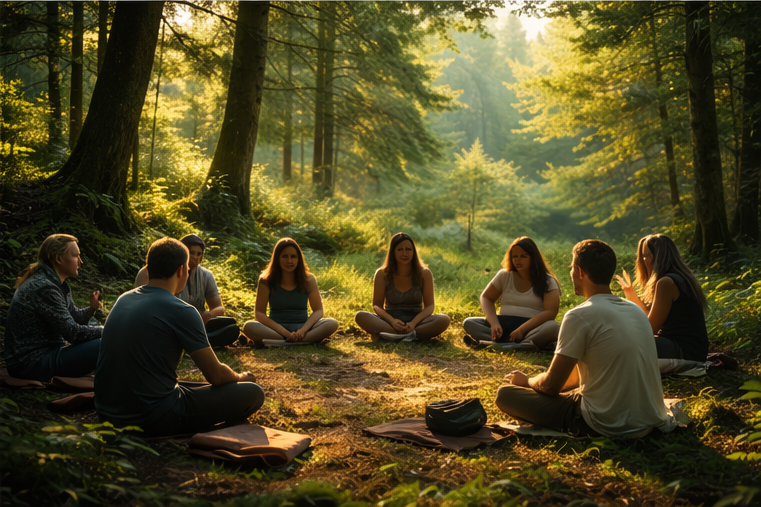
In forests and rivers, there is no argument about truth. There is rhythm. Flow. Intrinsic order. Life moving as life moves. We can feel what is real when we step into it.
The dialogue did not resolve what truth is.
It revealed something else:
Truth may not be something we secure.
It may be something we become more available to—together.
Collective sense-making is not about agreement. It is about increasing our capacity to be moved without collapsing. To love without naivety. To question without disconnection. To hold identity lightly enough that something larger can flow through.
If illusion is rigidity, perhaps truth is movement.
For those who were there—may this reflection stir recognition.
For those who were not—consider this an invitation.
Not to arrive at certainty.
But to practice being moved.
Because when we allow ourselves to be moved, something in the field shifts.
And perhaps that is where truth begins.