Staying Human
Being Touched by Life
What does it mean to stay human in a world that seems to be changing faster than we can fully comprehend?
We gathered with this question in mind, aware of the growing influence of technology, the demands on our attention, and the ways speed, uncertainty, and polarization can affect our relationships. Yet our conversation began somewhere much simpler.
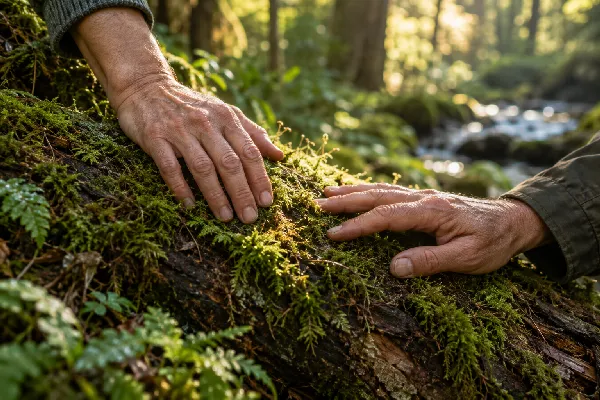
We were invited to look at our hands.
These familiar parts of ourselves, so easily overlooked, became a doorway into something surprisingly intimate. Hands that create and hold, reach and withdraw, offer care and receive it. Hands that carry the marks of aging, the resemblance of a parent, the memory of someone we love. Hands that connect us with the world and remind us of our vulnerability and mortality.
As we listened to one another, a thought began to take shape: perhaps being human is, in part, our capacity to be touched by life.
Not only through physical contact, but through everything we encounter—the warmth of an animal resting in our lap, a sunrise over the ocean, the tenderness of another person's story, the sadness of separation, the joy of creating something, or the uncertainty of not knowing what comes next.
To be human is to be affected. To feel life moving through us, sometimes beautifully and sometimes painfully.
When We Lose Touch
From this place of connection, we turned toward another question: What tends to pull us away from feeling deeply human?
We recognized familiar patterns. Retreating into our intellect when we long for intimacy. Staying with ideas rather than risking a more personal encounter. Numbing ourselves through distraction. Becoming caught in expectations about who we should be or how we should behave. Allowing fear, judgment, or the demands of our social and economic systems to shape how we experience ourselves.
Technology entered the conversation, including artificial intelligence, but not simply as something threatening our humanity. We wondered about our relationship with it, about what it means to feel moved by an interaction with AI, and about the assumptions we bring to questions of intelligence, feeling, and connection.
Yet something unexpected began to emerge.
When we judge ourselves for being distracted, disconnected, afraid, or overly intellectual, are we creating another division within ourselves? Are these experiences somehow less human than compassion, presence, or love?
Perhaps our tendency to judge, protect ourselves, withdraw, and become confused is also part of being human.
This didn't mean that every pattern serves us equally well, or that our choices have no consequences. Rather, it opened a different possibility: we can notice what is happening within us without first declaring it wrong.
And in that noticing, something may begin to change.
Making Room for More of Ourselves
Our next inquiry asked:
What becomes possible when more of our humanity has a place?
At first, the question seemed to invite visions of a better world—greater compassion, peace, connection, and understanding. But the conversation soon moved beyond imagining an ideal future.
What if making room for more of our humanity isn't primarily about becoming something new? What if it involves allowing some of what we have learned to suppress, avoid, or judge to become part of our experience again?
We spoke of compassion, acceptance, and the possibility of meeting the full range of our emotions without needing to divide them into acceptable and unacceptable parts.
Grief became particularly important here. So did fear, tenderness, longing, and the vulnerability of expressing what is genuinely present.
In a culture that often rewards composure, certainty, and competence, allowing ourselves to be emotionally visible can feel risky. We may fear losing acceptance, belonging, security, or the image of ourselves we have worked to maintain.
Yet the risk of remaining hidden also became apparent.
What happens when we continually hold back the very parts of ourselves through which deeper connection might become possible?
Perhaps staying human involves more than cultivating our preferred qualities. It may ask us to develop the compassion and courage to meet the parts of ourselves we would rather not reveal.
Wholeness may have less to do with becoming a better version of ourselves and more to do with becoming available to the fullness of who we are.
The Courage to Be Present
As the conversation deepened, the question of risk opened into an exploration of choice, freedom, and the unpredictable movement of life.
How much of what we do is consciously chosen? How much arises from our conditioning, experiences, relationships, and circumstances? And what does it mean to exercise agency while recognizing that we are continually being shaped by forces beyond our control?
Different perspectives remained in the circle. Some emphasized our capacity to choose how we respond. Others wondered whether choice itself is more mysterious than we generally assume. Images of flow, surrender, and dandelion seeds carried by the wind helped us explore the relationship between intention and the unexpected.
There was no need to resolve these differences.
Instead, another possibility became visible: perhaps we can participate more fully in life without needing to understand or control all of it.
We can make choices while acknowledging uncertainty. We can take risks without knowing the outcome. We can be present with fear without allowing it to determine everything that follows.
And perhaps we can become more playful—more willing to experiment, discover, and be surprised by what life brings.

The Humanity Between Us
Something important was happening in the conversation itself.
There were long pauses. Moments when nobody seemed to need to speak. Times when someone offered an unfinished thought and others allowed it to remain unfinished. Feelings surfaced without needing to be explained away. Questions opened into more questions.
Rather than moving toward a shared definition of humanity, we were experiencing some of the qualities we had been exploring.
We listened. We were moved. We noticed our own assumptions. We allowed uncertainty to remain. And we discovered how much connection can arise when people are not required to have something particularly insightful or complete to say.
One participant spoke of the freedom to express something that had not yet found words. Another recognized the possibility of being more patient with a familiar personal pattern. Others left with a renewed sense of curiosity, spontaneity, and willingness to explore life.
Perhaps the silence was as important as anything spoken.
It offered room for what was emerging within each of us—and for the experience of being together without needing to fill every moment.
Staying Human Is a Practice
We began by wondering what helps us remain deeply human amid extraordinary change.
We didn't leave with a definition, a set of instructions, or a list of capacities we must master. Instead, we encountered something both simpler and more demanding.
Perhaps staying human is not about protecting some idealized version of humanity from a changing world. It is about remaining willing to experience life as it is, with all its beauty, contradiction, tenderness, uncertainty, and possibility.
It is about noticing when we withdraw and meeting that withdrawal with curiosity. Recognizing our judgments without becoming entirely defined by them. Allowing grief and joy, fear and courage, certainty and not knowing to have a place.

And remembering that our humanity is not something we experience only within ourselves. It is continually revealed and shaped in relationship—with other people, with the living world, and with whatever life brings into our awareness.
The world will continue to change. Technology will evolve. Our familiar ways of understanding ourselves may be challenged again and again.
Perhaps the invitation is not to become more certain about what makes us human.
Perhaps it is to remain open enough to be touched by life—and by one another.
And to discover, together, what being human continues to mean.