The Space Between Me and We
A reflection from our May 21 Bohmian Dialogue
On May 21st, we gathered in open Bohmian dialogue without a theme, agenda, or destination. And yet, as often happens in these spaces, something coherent quietly began to emerge.
The conversation opened with contrasts. Some arrived carrying anxiety, sadness, or a deep compassion for the state of the world. Others spoke of playfulness, curiosity, or relief at entering a space that felt slower, safer, and less judgmental than much of everyday life. One participant noticed feeling unexpectedly unsafe simply because everyone was new. Another spoke of feeling pulled in different directions while still sensing they were on the right path.
Almost immediately, the dialogue began circling around a question both ancient and immediate:
What does it mean to be human together?
The Tension Between “I” and “We”
At one point, the conversation turned toward the idea of “we.”
What is this “we” people speak about?
Who belongs inside it?
Who fears being left outside of it?
Some spoke of unity, oneness, and humanity moving toward a more connected way of being. Others felt resistance to spiritualized ideas of collective awakening. There was caution around language that subtly divides humanity into those who are “awake” and those who are not.
One voice asked quietly: “Am I included in that we?”
The question landed deeply.
Again and again, participants returned to the tension between individuality and unity—between “I” and “we.” One participant recalled someone inventing a word for this paradox:
“Mwe.”
Not me.
Not we.
Both.
And slowly, something softened around the assumption that separation itself is a problem.
Falling in Love With Difference
Several participants noticed a subtle striving inside themselves—a striving for connection, unity, transcendence.
But what if separation also has something to teach us?
What if difference is not an obstacle to connection, but part of what makes connection meaningful?
One reflection lingered in the room:
“Maybe it’s not about falling in love with unity, but falling in love with difference.”
Without separation, perhaps we cannot fully recognize one another’s gifts. Without the space between us, we may never truly encounter the other—or ourselves.
The dialogue did not resolve the tension between individuality and unity.
Instead, it began to honor the movement between them.
Can we respect the movement between “I” and “we”?
Can we suspend judgment toward ourselves when we feel separate?
One participant spoke simply: “I’ll sit in separation a little longer.”
And in the safety of the space, separation no longer felt like failure.
Humanity, AI, and What Cannot Be Automated
As the dialogue unfolded, another thread emerged:
Artificial intelligence.
What makes humans different from machines?
What remains uniquely human in a world increasingly shaped by automation?
Several participants reflected that AI may eventually perform much of the work humans currently do. But then what?
If work no longer defines us, what is life for?
The conversation moved away from productivity and toward something more subtle:
Presence.
Contemplation.
Relationship.
One participant reflected that AI may process information, but it does not contemplate in the way humans do. It does not sit inside uncertainty wondering whether to speak or remain silent. It does not witness its own inner process unfolding in real time.
Perhaps part of what makes us human is not merely intelligence, but our capacity for:
self-reflection,
love,
contemplation,
and relational awareness.
Pausing Long Enough to Notice
Again and again, the dialogue returned to pace.
The speed of modern life.
The transactional rhythm of the world.
The subtle exhaustion of constant movement.
One participant described watching their son care for a strawberry plant and a mint plant—pausing to water them, nurture them, notice them. Another reflected on the difference between browning bread slowly over a fire and simply dropping it into a toaster.
In both stories, something essential appeared:
Process.
Not rushing toward outcomes, but remaining present with what is unfolding.
Roasting marshmallows over a fire became another metaphor. If we leave the fire unattended, the marshmallow burns. Presence cannot be automated.
And perhaps this is what many people are longing for:
Not efficiency.
But participation.
Not acceleration.
But relationship with life itself.
Nature, Silence, and the Whisper Beneath the Noise
Nature entered the dialogue repeatedly.
Several participants spoke of finding connection, spirituality, or grounding not through abstract ideas, but through direct relationship with the natural world.
One person shared a story about a rat crossing the road slowly enough to cause them to stop their car—only to discover moments later that the pause had prevented a collision with an oncoming truck. Another reflected on their dog reacting fearfully to the sound of the Tibetan singing bowl at the beginning of the session, noticing how instinctively they could understand the animal’s experience.
These moments carried a quiet recognition:
We are not separate from life around us.
Humanity itself may be inseparable from our relationship with the more-than-human world.
Silence also emerged as its own teacher.
Not empty silence.
Not absence.
But a deeper stillness beneath the noise of thought and conversation.
One participant described how silence can initially feel loud and busy, but when cultivated patiently, it becomes possible to hear a quieter voice underneath it all—a subtle whisper always present, whether speaking or not.
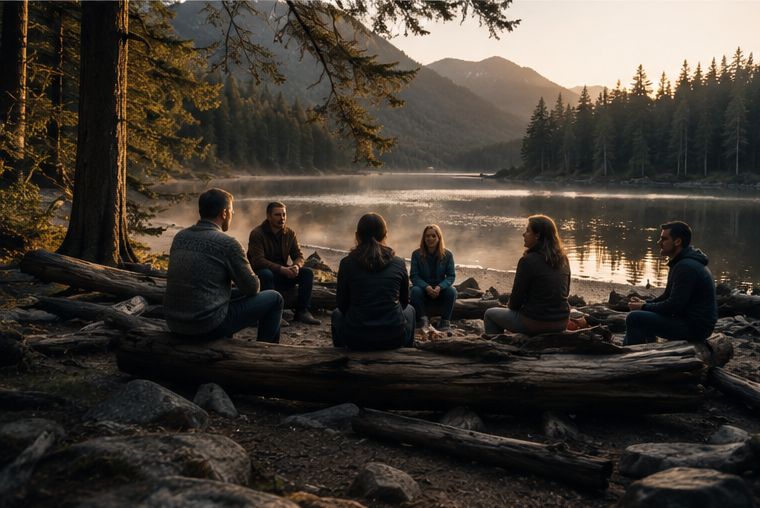
The Space Between Us
As the dialogue came to a close, one final insight surfaced:
What connects us may actually be our differences.
Not despite the space between us.
But through it.
Like synapses between nerves, there is a gap across which something moves. Meaning, relationship, understanding—all arising not through sameness, but through connection across difference.
One participant described the group itself as a kind of recipe, each person an ingredient contributing something essential to the whole.
Another reflected: “I feel like I’m being marinated here.”
Something was happening slowly, relationally, almost invisibly.
Not a conclusion.
Not a consensus.
But a shared experience of being human together.
What Remains
No final answers emerged from the dialogue.
Only invitations.
To pause.
To listen beneath words.
To sit a little longer in uncertainty, difference, and silence.
To recognize that separation and connection may not be opposites after all.
And perhaps most importantly:
To remember that life is not merely something to solve or optimize.
It is something to participate in.
Together.
For those who were present, may this reflection bring back the feeling of the space between us.
For those who were not, consider this an invitation.
Not into agreement.
But into relationship.
Because sometimes what connects us most deeply is not our sameness—
but our willingness to remain present with difference.